
Santa Clara Court Records After Arrest
After a Santa Clara County jail arrest, two public record tracks may exist at the same time. The Sheriff custody track begins with booking at the Main Jail or another intake channel and can show public custody information such as bail, charges, warrants, holds, initial court date, and projected release date. The court track starts when the Santa Clara County District Attorney authorizes and files formal charges in Superior Court. Those court records after an arrest are the better source for what the person is actually accused of in court.
The difference matters because booking charges can change. Law enforcement may book a person on one set of suspected offenses, then the District Attorney's Issuing Unit reviews the reports and decides which charges to file, amend, reduce, or decline. For the custody side, use the Santa Clara County jail inmate records page. For booking-photo access, use the Santa Clara County jail mugshots page. For formal case events, use the court and clerk channels below.
Santa Clara Court Case Search
The Superior Court provides online case information and a public criminal case portal, but the court warns that filings are not generally available online. The portal and criminal case index help locate case information. Copies of pleadings, minute orders, complaints, sentencing documents, or other records usually require the case number and a clerk request in person or by mail.
The Superior Court case information page and the public case portal are the main starting points. The court's criminal case records page also explains the index, courthouse filing locations, copy rules, and restricted criminal documents.
| Field Label | Type | Required | Notes |
|---|---|---|---|
| Defendant name | Text | Yes for name search | Use the name tied to the criminal filing, not a nickname from the jail roster. |
| Date of birth | Date/text | One index path | Used with defendant name for cases filed in 2004 or later. |
| Filing month/year | Month/year | Alternative | Use with defendant name when the date-of-birth path is not available. |
| Case number | Text | Needed for copies | The court says a case number is needed to see or copy many public records. |
| Business or warrant name | Split text fields | As applicable | The court index PDF gives special Last Name and First Name formatting rules. |
The Santa Clara Superior Court public case portal screenshot below shows the official court search entry point used after the jail arrest and prosecutor filing stages.
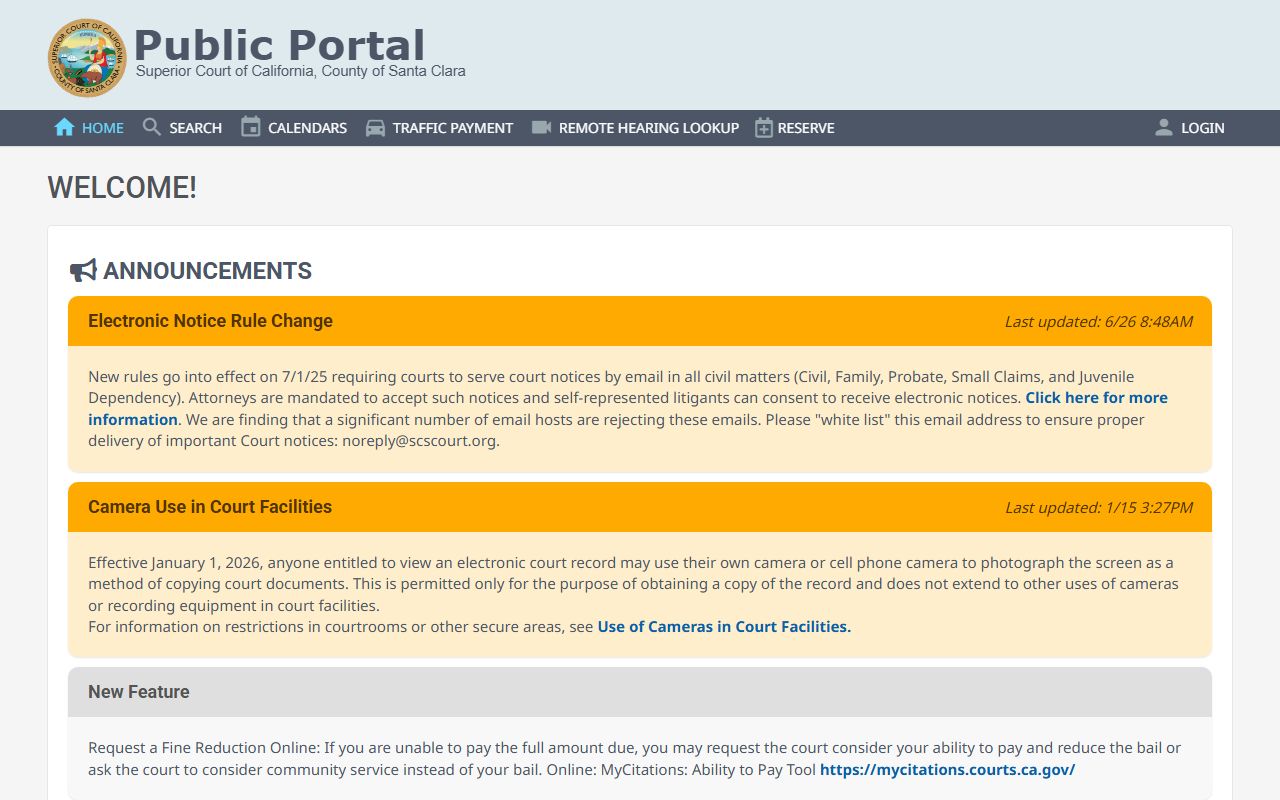
Use the portal to find case identifiers and status cues, then use clerk copy channels when the actual court document is needed.
Find Charges After Arrest
Santa Clara County court records after a jail arrest often lag behind the booking record. A person can be booked before the prosecutor files a complaint, and a search may fail during that gap. If the person is still in county custody, the Sheriff's Administrative Booking line can provide public custody details while the court case is pending filing.
- Search the county "Who's in Custody" portal or call Administrative Booking at (408) 299-2305 for booking number, PFN, bail, holds, warrants, and the first listed court date.
- Allow time for District Attorney review. The DA Issuing Unit reviews law-enforcement cases and authorizes formal charges.
- Search the criminal case index by defendant name with date of birth, or by defendant name with filing month and year.
- When the case number appears, use it to request the docket, complaint, minute order, sentencing document, or other public court record.
- For pre-2004 cases, use courthouse microfiche with defendant name, date of birth, and filing year.
Mail copy requests should specify the case number, full defendant name, date of birth, and exact document sought. The court says clerk copies are $0.50 per page, and search fees may apply when a search takes longer than 10 minutes. For unknown copy totals, the court suggests a check payable to the Clerk of the Superior Court with a "not to exceed" notation.
Santa Clara Charging Documents
The charging document is the bridge between a jail arrest and a court record. It turns an arrest event into a filed criminal case. In Santa Clara County felony matters, the court's felony process describes arrest, jail, arraignment, preliminary hearing, the filing of an Information if the defendant is held to answer, and trial timing unless time is waived.
| Document | Who Files It | When It Matters | Santa Clara Notes |
|---|---|---|---|
| Complaint | Prosecutor | Starts many misdemeanor and felony cases | May differ from the booking charge after DA review. |
| Information | Prosecutor | Filed after a felony preliminary hearing hold-to-answer | The court says it must be filed within 15 days after the hold-to-answer. |
| Indictment | Grand jury | Used in some serious or grand-jury matters | Less common than complaint or Information for routine post-arrest searches. |
The District Attorney's Office is the largest prosecuting agency in Northern California and handles more than 40,000 cases a year. DA contact is separate from the Sheriff and separate from the court clerk. That agency split is why a Santa Clara County arrest record, a jail roster entry, and a court record may not display the same information on the same day.
Santa Clara Charge Status
Charge status can shift as the case moves from arraignment to pretrial hearings, plea, dismissal, trial, or sentencing. A pending charge is an accusation. It is not a conviction. Court records after an arrest should be read count by count because one charge may be dismissed while another is amended, reduced, or resolved by plea.
| Status | What It Means | Where to Verify |
|---|---|---|
| Pending | The charge is filed and not yet resolved. | Superior Court portal or clerk record. |
| Amended | The prosecutor changed the filed count or code. | Complaint, amended complaint, Information, or minute order. |
| Reduced | The charge level or offense was lowered. | Minute order, plea record, or sentencing record. |
| Dismissed | The count or case was dropped by court action. | Disposition entry or signed order. |
| Convicted | A plea or verdict resulted in guilt on that count. | Disposition, plea minute order, or sentencing record. |
Note: A jail roster charge can be an early custody label; the filed court charge controls the criminal case record.
Bond After Santa Clara Arrest
The Sheriff Administrative Booking page says bail can be posted from 5:00 a.m. to 12:00 a.m. Accepted payment methods include cash, bank cashier's check, money order, or bail bond. Cashier's checks and money orders for bail must be payable to Santa Clara County Judicial District. The Sheriff's Office states it cannot refer people to bail bond agencies.
| Release Type | How It Works | Record Impact |
|---|---|---|
| Cash bail | The full bail amount is paid directly. | Custody may end, but the court case remains open. |
| Cashier's check or money order | Certified funds are used for bail. | Must follow the county payee rule. |
| Bail bond | A bail agent posts bond for release. | The Sheriff will not recommend an agency. |
| Own recognizance | The judge releases the defendant on a promise to appear. | The next court date still controls. |
| No-bail or hold | A warrant, detainer, or court order blocks ordinary release. | Administrative Booking can identify public holds for current custody. |
Warrants After Court Arrest
No official online active warrant search was located for the Santa Clara County Sheriff. The official warrant channel in the research is the Sheriff Records Division in-person process. A warrant check requires the subject's name and date of birth. Self-checks require proper identification, and staff can advise options such as scheduling a court date, posting and forfeiting bail, paying bail for a court date, or posting bond through a bondsman.
The court has a separate bench-warrant and arrest-warrant arraignment policy. A person with an active bench warrant may be able to self-calendar and appear out of custody, but the warrant remains active until the new appearance. Arrest-warrant arraignment matters require attorney assistance under the court policy described in the research.
Charges, Convictions, Sealing
Santa Clara County court records after arrest should not be read as proof of guilt. Charges are allegations filed by the prosecutor. A conviction requires a plea or verdict. California law also provides record relief for some arrests that did not result in conviction and dismissal relief for some convictions, but those processes do not erase every government record from every lawful use.
| Question | Charge | Conviction |
|---|---|---|
| Stage | Filed accusation after arrest review. | Final guilt finding by plea or verdict. |
| Proof level | Filing and probable-cause standards. | Beyond a reasonable doubt or accepted plea. |
| Public meaning | Shows what was alleged. | Shows the resolved criminal outcome. |
California Penal Code 851.91 allows eligible people to petition to seal arrest records that did not result in conviction, and Penal Code 851.92 addresses transmission of sealing orders. Penal Code 1203.4 concerns dismissal relief after certain convictions.
| Relief Type | Plain Meaning | Santa Clara Record Effect |
|---|---|---|
| Sealed arrest record | Public access is restricted for an eligible non-conviction arrest. | The court order and agency update control the practical result. |
| Dismissal relief | An eligible conviction may be dismissed under California law. | The conviction is not treated as if it never existed for all purposes. |
| Expungement wording | Common public term for record relief. | California relief is statute-specific, so read the order and code section. |
Restricted Santa Clara Court Records
Not all criminal case material is public. The court's criminal records page lists restricted items such as arrest reports, documents listing a victim's name, address, or telephone number, probation reports, domestic violence protective orders, own recognizance reports, criminal history information, and financial or medical information. Public access terminals at courthouses are a fallback for open records when online access is limited.
Important: Consumer reporting, employment screening, tenant screening, insurance, and credit decisions require legally compliant sources, not casual court or jail lookups.
California's Public Records Act governs public-record access, while law-enforcement exemptions and Penal Code 13300 limit local criminal history dissemination. The Sheriff and court may redact or withhold protected records when state law requires it.
Public Record Search
Sponsored Results